
This article is intended for Sales Managers and Service Technicians and provide them with better understanding and importance of clearances required for installing Airsys SAS units
Background
Properly accounting for clearance and space requirements is essential when installing the Airsys SAS Units to ensure optimal performance, safety, and long-term dependability. Sufficient space around the unit allows for effective airflow and heat transfer while also ensuring technicians have the access needed for routine maintenance and service. This is especially important in school settings, where installations are often in tight spaces, making adherence to clearance guidelines key to avoiding operational problems and meeting safety and code requirements.
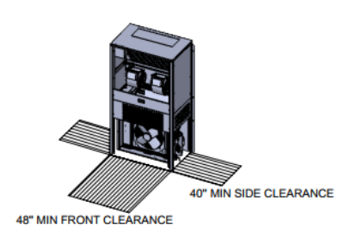
When installing the Airsys School Air Solutions unit it is required to maintain following clearance criteria
- A minimum of 48" (1200 mm) of free space in front of the unit.
- A minimum of 40" (1000 mm) of free space at the side of the unit.
- A minimum of 6" (150 mm) of free space beneath the unit.
In addition to general clearance requirements, several critical safety considerations must be followed during CV60 installation. These guidelines ensure the unit is securely mounted, minimizes fire risk, and complies with applicable safety standards.
- Ensure the mounting wall is strong enough to support both the unit’s weight and any vibration during operation.
- Keep at least 1 foot of space between the unit and any combustible materials.
- For ducted installations, maintain a minimum of 1 inch clearance between the supply air opening and combustible materials.
- Maintain at least 18 inches (457 mm) between the supply air duct surface and any flammable materials. Always verify compliance with local building codes and NFPA 70.
- If the unit is connected to ducts, ensure a minimum clearance of 1 inch between the duct's supply air opening and combustible materials.
- The unit must be installed on a level surface. Any tilt greater than 0.24–0.28 inches (6–7 mm) or ±1° may result in condensate overflow from the drain pan.