This article is intended for sales engineers, service technicians, and design engineers working with AIRSYS School Air Solution units. It provides a clear understanding of Enhanced Vapor Injection (EVI), helping sales teams communicate its value, supporting technicians in operation and troubleshooting, and giving engineers practical insight into its impact on performance and system application.
Background
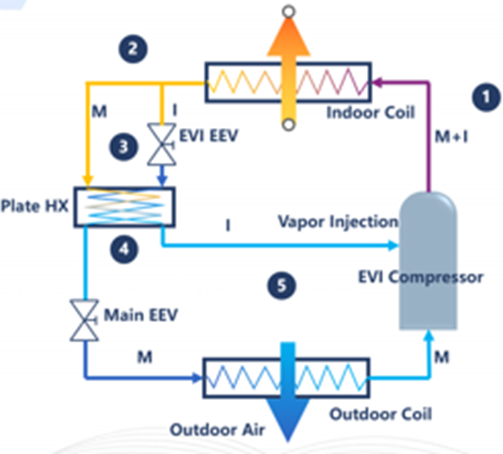
In an EVI system, liquid refrigerant is split into two paths. One portion follows the normal cycle, while the other is expanded in the plate heat exchanger to create a mixture of liquid and vapor. The vapor is then injected into the compressor at an intermediate stage, boosting capacity and reducing discharge temperature, resulting in improved overall system performance
How it differs from a standard heat pump cycle:
Unlike a conventional heat pump, which follows a single-stage compression process, EVI introduces an intermediate step where refrigerant is partially expanded and injected into the compressor. This increases mass flow and improves efficiency, particularly under low ambient conditions.
Key components:
- Compressor with vapor injection port
- Plate heat exchanger (intermediate heat exchanger)
- Expansion device (typically an electronic expansion valve, EEV)
How EVI Works
- The compressor raises the refrigerant to a high-pressure, high-temperature gas
- It flows to the condenser, where it cools, condenses, and splits into two streams: larger stream (M) and smaller stream (I)
- The larger stream enters the plate heat exchanger, while the smaller stream expands through the EVI valve and enters another pipe of the heat exchanger
- The small stream absorbs heat, increasing subcooling of the larger stream
- The small stream vapor returns to the compressor, while the large stream passes through the main expansion valve, outdoor coil, and back to the compressor
Benefits for the compressor
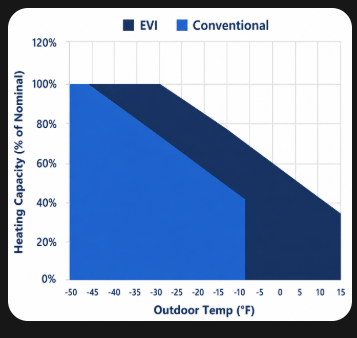
Inside the compressor, vapor injection lowers the discharge temperature, allowing it to run cooler and reducing thermal stress, while also increasing refrigerant flow through the system. As a result, the unit maintains higher heating capacity, particularly at low outdoor temperatures.
Performance Benefits in AIRSYS Units
- Improved heating capacity at low outdoor temperatures:
EVI helps maintain heating output when ambient temperatures drop, where standard heat pumps typically lose capacity. - Extended operating range:
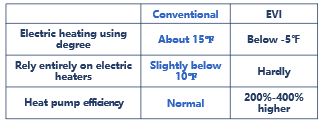
Enables reliable operation in very low outdoor conditions, reducing performance degradation in cold climates. - Reduced need for electric heat:
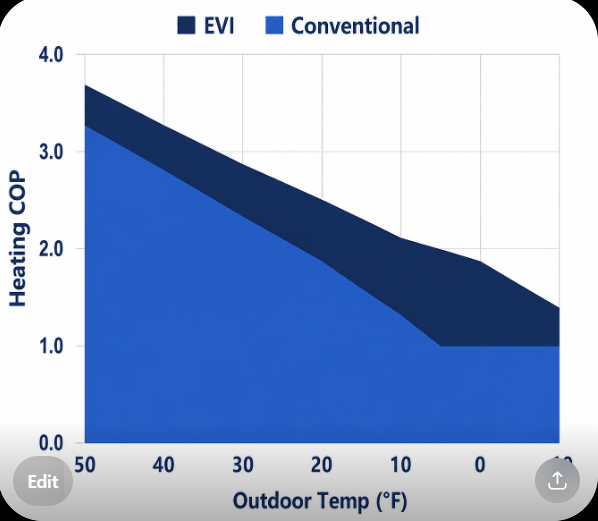
By boosting heating capacity, EVI minimizes or eliminates reliance on auxiliary electric heaters, improving overall efficiency. - Better COP compared to conventional systems:
More efficient compression and increased mass flow result in higher Coefficient of Performance (COP), especially in heating mode. - Stable performance under variable load:
Works seamlessly with variable speed (VFD) compressors to provide smooth capacity modulation, better temperature control, and consistent operation across changing load conditions.
Application in School Air Solutions
Why schools benefit:
Schools require significant outside air (OSA) to meet IAQ standards. EVI helps offset the added heating load from bringing in large amounts of outdoor air, especially in winter.
Classrooms experience changing occupancy throughout the day. EVI supports consistent performance under fluctuating loads by maintaining capacity even at part-load conditions.
Combined with variable speed technology, EVI enables smooth operation with reduced cycling, supporting low noise levels and energy efficiency—critical in learning environments.
Integration with AIRSYS features:
EVI enhances performance across the full modulation range of variable speed compressors, improving both efficiency and capacity at low and high speeds. It also works effectively with fresh air systems such as CRV, ERV, and economizers by handling the additional heating demand from outside air without compromising comfort or efficiency.
Design Considerations
When to select EVI:
- Cold climates:
Ideal for applications where outdoor temperatures drop significantly, and maintaining heating capacity is critical. - High outside air (OA) systems:
Recommended for systems with high ventilation requirements, where additional heating load from OA can reduce performance in standard heat pumps.
The influence of enhanced vapor injection on heat output
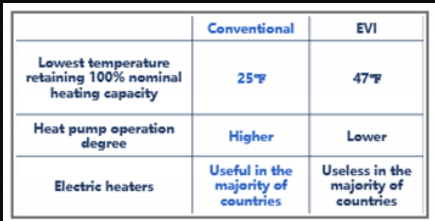
The influence of enhanced vapor injection on heat efficiency