
Background
This article is intended for sales teams and customers seeking a clear understanding of system performance for SAS applications. It provides a concise overview of how different solutions operate under varying conditions, helping readers make informed decisions that balance efficiency, comfort, and application requirements
Rev C ensures reliable cooling while optimizing efficiency.
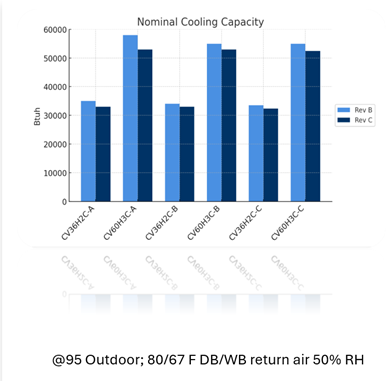
The chart illustrates nominal cooling capacity (Btuh) for various unit sizes, comparing Rev B and Rev C under standard conditions (95°F outdoor, 80/67°F return air, 50% RH). In general, Rev B delivers slightly higher capacity across all models, although the variation between the two revisions is minimal and consistent. While Rev C shows a small reduction in capacity, it is optimized to provide enhanced efficiency and better performance across different load conditions.
Rev C keeps spaces comfortable with steady, dependable heating 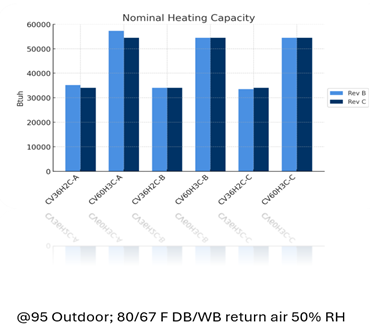
The chart presents nominal heating capacity (Btuh) for different unit sizes, comparing Rev B and Rev C under standard conditions (95°F outdoor, 80/67°F return air, 50% RH). Overall, both versions deliver nearly identical heating performance, with only slight differences across models. While Rev B is marginally higher in some cases, Rev C closely matches it, demonstrating comparable heating capacity with a focus on improved efficiency and consistent performance.
Rev C maximizes efficiency, reducing wasted energy.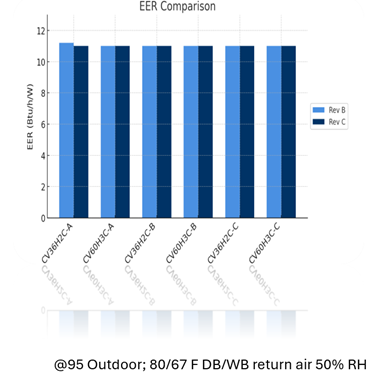
The chart compares EER (Energy Efficiency Ratio) for various unit sizes between Rev B and Rev C under standard conditions (95°F outdoor, 80/67°F return air, 50% RH). Overall, both revisions exhibit very similar efficiency levels, with Rev C closely matching or slightly improving upon Rev B in most cases. This indicates that Rev C maintains comparable cooling efficiency while delivering consistent and optimized performance across different units.
Rev C maintains high efficiency across varying loads, ensuring smarter saving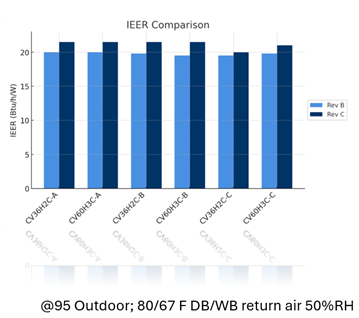
The chart presents a comparison of IEER (Integrated Energy Efficiency Ratio) for different unit sizes between Rev B and Rev C under standard conditions (95°F outdoor, 80/67°F return air, 50% RH). Overall, Rev C consistently achieves higher IEER values across all models, reflecting enhanced part-load efficiency. This indicates that Rev C provides improved energy performance under varying operating conditions, leading to increased overall energy savings.
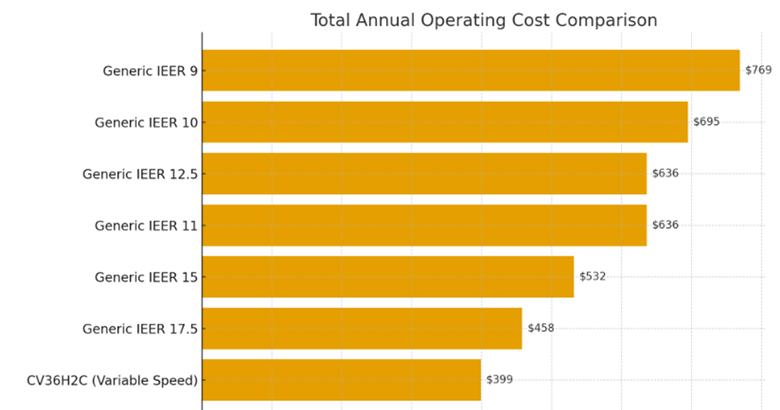
Estimated Energy Savings Comparison with AIRSYS SAS
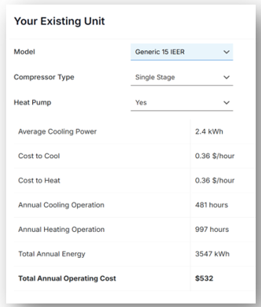
Utility Calculator
The utility calculator provides a side-by-side comparison of operating costs between an existing unit and a proposed AIRSYS unit based on user-defined inputs such as location, load, setpoints, and utility rates. The example highlights significant energy and cost savings with the proposed unit, driven by lower power consumption and improved efficiency, resulting in reduced annual energy usage and operating expenses.
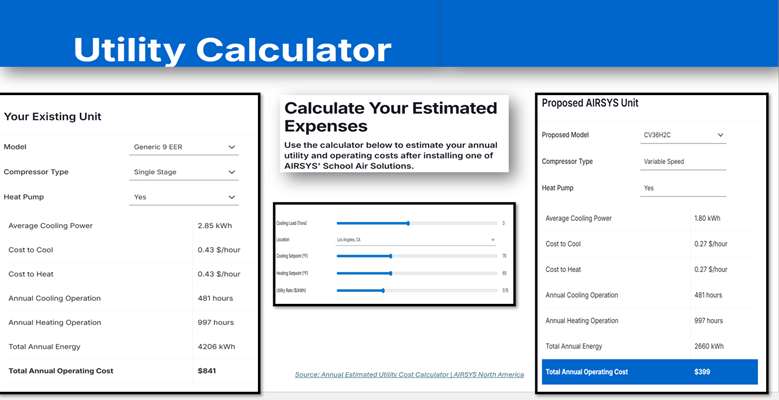
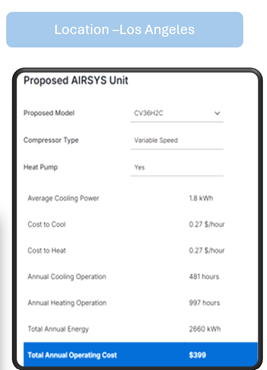
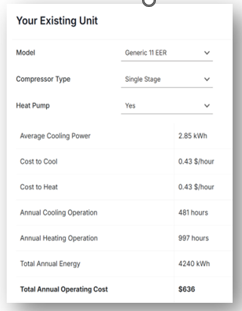
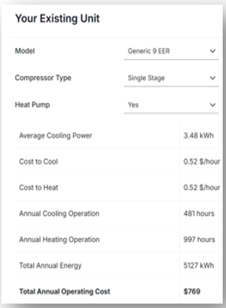
- The snippet compares the proposed AIRSYS unit with existing units with different EER rating for a Los Angeles application, highlighting differences in energy use and operating costs. It shows that the AIRSYS unit, with its higher efficiency and variable speed operation, delivers lower annual energy consumption and reduced operating costs compared to conventional single-stage systems.
Total Annual Operating Cost and Energy Use by Model
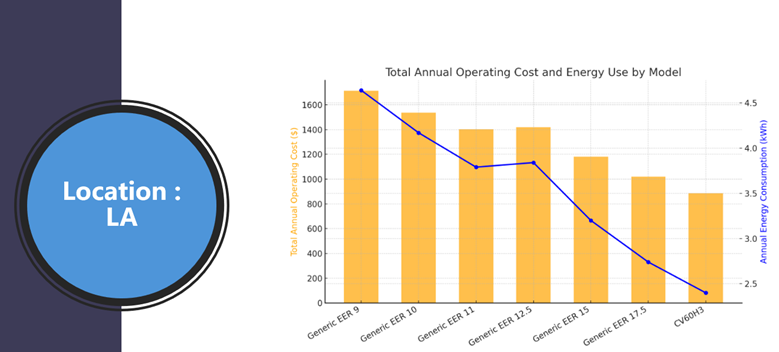
The graph illustrates the relationship between total annual operating cost and energy consumption across different unit efficiency levels for a Los Angeles location. As efficiency (EER) increases, both energy consumption and operating costs decrease, with the AIRSYS unit (CV60H3) demonstrating the lowest values. This highlights the significant cost savings and energy reduction achieved by higher-efficiency systems.
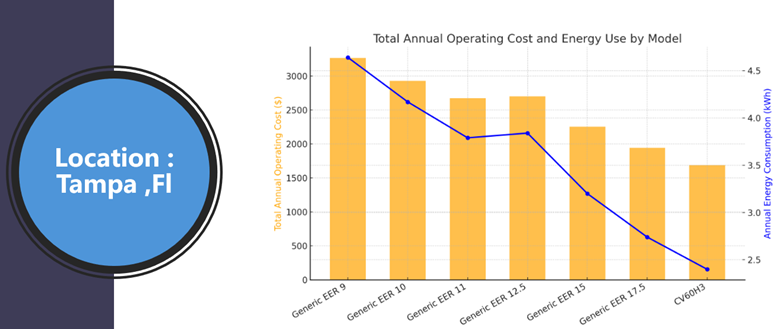
The graph shows total annual operating cost and energy consumption for different unit efficiency levels in a Tampa, FL location. As system efficiency (EER) increases, both energy use and operating costs steadily decline, with the AIRSYS unit (CV60H3) achieving the lowest values. This demonstrates the greater impact of high-efficiency systems in warmer climates, where cooling demand is higher and energy savings are more significant.
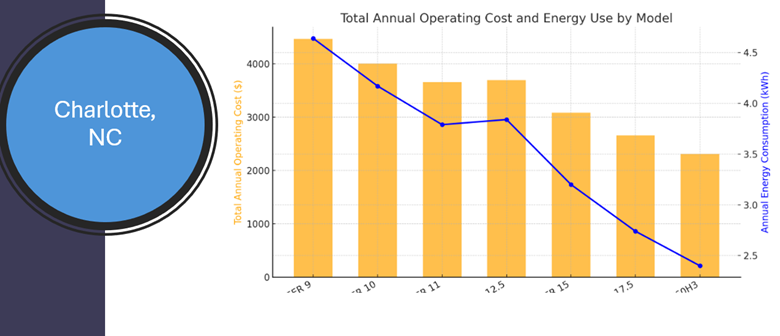
The graph illustrates total annual operating cost and energy consumption across various unit efficiency levels for a Charlotte, NC location. As efficiency (EER) increases, both energy usage and operating costs decrease, with the AIRSYS unit (CV60H3) showing the lowest values. This highlights the benefits of higher-efficiency systems in reducing operational expenses and improving energy performance in mixed climate conditions.